
Did you know over 80% of tech leaders now seek specialized tools beyond famous open-source hubs? They aim to meet their machine learning goals. Searching for a Hugging Face alternative AI platform can reveal new opportunities for your projects. You might seek faster speeds, lower costs, or unique features that fit your workflow today.
The digital world changes quickly, and staying ahead means exploring all your options. You deserve a solution that grows as fast as your ideas. Finding the right fit requires a detailed AI platform comparison to see how each system handles your data.
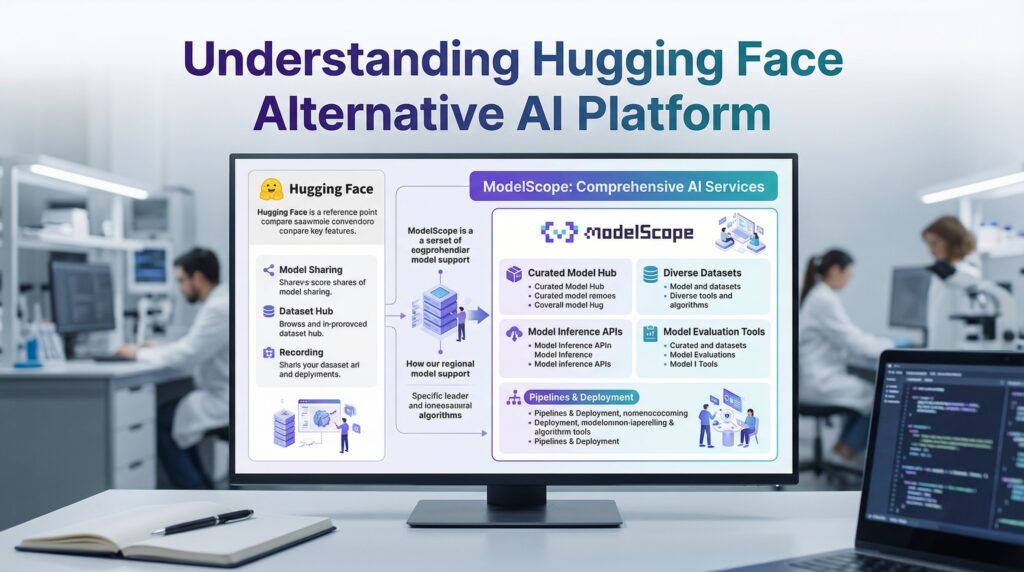
One rising platform worth mentioning is ModelScope, an emerging AI model hub that functions similarly to Hugging Face. It allows users to explore, test, and deploy free machine learning models directly in the browser or through APIs, making it a strong choice for developers looking for flexible and open-source AI solutions.
This guide will help you understand the choices by comparing performance and costs across the platform market. You’ll learn which features are most important for your success. You’ll also discover how to choose the best tool for your future growth. Exploring different services ensures you get the best results.

You can find better ways to build, test, and deploy your newest models with ease. This journey will change how you view machine learning resources and their hidden possibilities.
Key Takeaways
- Explore diverse services to find specialized machine learning capabilities.
- Analyze total costs and processing speeds before making a final choice.
- Prioritize tools that provide seamless integration with your current data sets.
- Evaluate the scalability of each service to support long-term project goals.
- Identify unique features that generic open-source hubs might not provide.
- Use detailed comparisons to ensure your team picks the most efficient path.
Understanding Hugging Face Alternative AI Platform
Exploring AI platforms is key, and knowing about Hugging Face and its rivals is essential. Hugging Face is well-liked for its wide range of models and easy-to-use interface. But, AI tech changes fast, so looking at other options can help you find the best fit for your needs.
A Hugging Face alternative AI platform can help teams align model access, deployment, and pricing with more specific project goals.
What is Hugging Face?

Hugging Face is a big name in AI, famous for its many pre-trained models and simple interface. It’s a top choice for developers and researchers wanting to add AI to their work. As “the GitHub of AI models”, it’s a place where people can share, find, and use AI models together.
“Hugging Face has changed how we work with AI models, making it easier and more collaborative.”
The platform helps with many AI tasks, like understanding language and seeing images. Its fame comes from making it easy to find, download, and use AI models. Still, a Hugging Face alternative AI platform may offer a different balance of openness, speed, and infrastructure support for production use. This speeds up the work of making and using AI.
Why Explore Alternatives?
Even though Hugging Face is great, looking at other options has its perks. It lets you see what else is out there, like different features and prices. In addition, a Hugging Face alternative AI platform can reveal niche capabilities that better match domain-specific workflows.
Also, some platforms focus more on certain AI areas, like computer vision or natural language processing. They might offer more advanced or specific tools than Hugging Face.

- Find new features not on Hugging Face.
- Look at prices to find the best deal.
- Check out platforms with special AI skills.
Platforms like ModelScope provide access to a wide range of open-source models, often with unique datasets and tools not available on Hugging Face. By looking at other options, you can choose the best platform for your project. As AI keeps changing, knowing what’s out there is key to using the right tech.
Key Features to Look for in AI Platforms
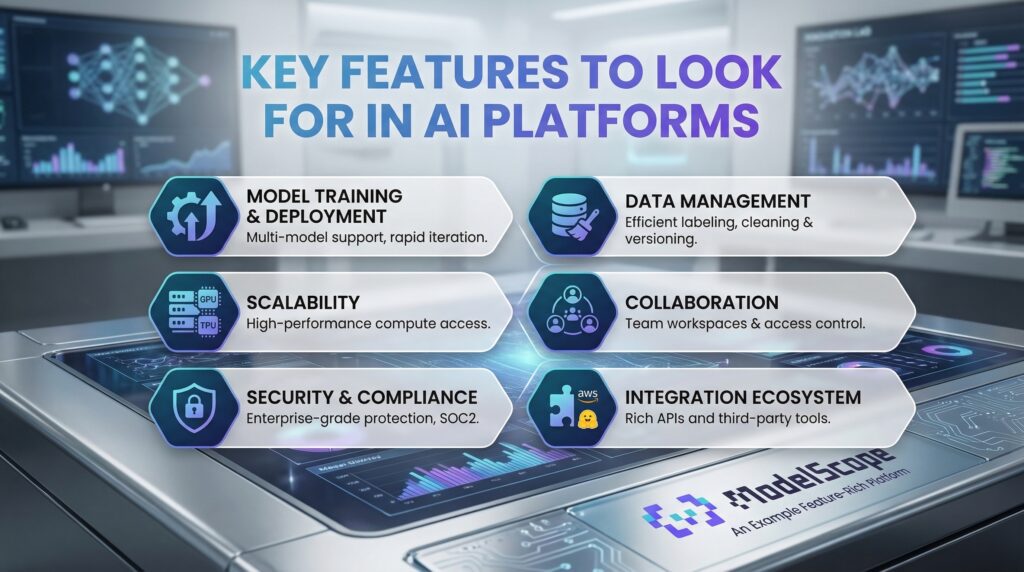
When looking at AI platforms, it’s key to focus on certain features. The AI world is always changing, with many platforms available. Knowing what features you need is important for your project’s success. Choosing a Hugging Face alternative AI platform becomes easier when you evaluate usability, deployment options, and long-term adaptability together.
Scalability and Flexibility
Scalability and flexibility are top considerations. Your project might grow, and the platform should grow with it. Look for platforms that can handle more tasks and data as needed. A strong Hugging Face alternative AI platform should scale smoothly as your workloads, users, and model complexity increase over time.
A good AI platform starts small but can grow with you. It should also be flexible, allowing you to customize it. This could mean changing models or adding new tools.
| Feature | Description | Importance Level |
|---|---|---|
| Scalability | Ability to handle increased load and complexity | High |
| Flexibility | Customization options for models and integrations | High |
| Adaptability | Ability to adjust to changing project needs | Medium |
User-Friendly Interface
A user-friendly interface is essential. A hard-to-use platform can slow down your team. Look for platforms with easy-to-use interfaces and good support.
An easy interface lets you focus on your work, not learning the platform. This makes starting and achieving results faster.
API Integration Capabilities
API integration is also key. Being able to connect the AI platform with your tools is valuable. For many development teams, a Hugging Face alternative AI platform is most useful when its APIs fit naturally into existing pipelines. Look for platforms with strong APIs and support for many programming languages.
Good API integration helps automate tasks and use existing data. This makes your workflow more efficient and cost-effective.
| API Feature | Description | Benefit |
|---|---|---|
| Robust APIs | Comprehensive and well-documented APIs | Simplifies integration |
| Multi-Language Support | Support for various programming languages | Increases versatility |
| Compatibility | Compatibility with popular tools and services | Enhances interoperability |
Top Hugging Face Alternative AI Platform
If you’re looking for alternatives to Hugging Face, you’re in luck. The AI world offers many platforms with different features. Each Hugging Face alternative AI platform in this category brings a distinct mix of model access, customization, and hosting support. From natural language processing to image recognition, there’s a lot to explore.

OpenAI’s API
OpenAI’s API is known for its versatility and wide range of uses. It’s great for tasks like text generation and understanding human language. This makes it perfect for chatbots and content creation.
Some key features of OpenAI’s API include:
- Advanced natural language understanding and generation capabilities
- Flexibility in handling a wide range of tasks
- Continuous updates with the latest AI models
Google Cloud AI
Google Cloud AI is a strong contender, with a range of AI and machine learning services. It’s scalable and can handle big datasets, making it great for big companies. It supports tasks like image and video analysis, and natural language processing.
Here’s a comparison of some AI platforms:
| Feature | OpenAI’s API | Google Cloud AI | IBM Watson |
|---|---|---|---|
| Natural Language Processing | Advanced | Advanced | Advanced |
| Image Recognition | Limited | Advanced | Advanced |
| Scalability | High | Very High | High |
IBM Watson
IBM Watson is famous for its strong AI abilities, like natural language processing and machine learning. It offers services like language translation and sentiment analysis. It’s great for businesses wanting to make the most of their data.
IBM Watson’s main features are:
- Advanced data analysis and insights
- Robust natural language processing capabilities
- Integration with various data sources
ModelScope AI
ModelScope is a growing AI platform that offers a large collection of open-source machine learning models across various domains, including NLP, computer vision, and audio processing. Similar to Hugging Face, it enables developers to test models online, integrate them via APIs, and build applications without starting from scratch.
Its strong focus on accessibility and free resources makes it especially attractive for beginners and indie developers.
Unlike many enterprise-focused platforms, ModelScope allows you to experiment with AI models instantly, without complex setup or high costs, making it ideal for creators, developers, and small teams.
When picking an alternative, think about what you need and what you’re working on. Each platform has its own strengths. Choosing the right one can really help your AI projects succeed.
Performance Comparison: Hugging Face vs Alternatives
Choosing the right AI platform means looking at how Hugging Face and others perform. We need to see how fast, accurate, and customizable they are. However, the right Hugging Face alternative AI platform is not always the fastest one, because real value also depends on reliability and fit.
Speed and Efficiency Metrics
Speed and efficiency are key for quick data processing. Let’s compare Hugging Face and its rivals in these areas.
| AI Platform | Processing Speed (ms) | Efficiency Score |
|---|---|---|
| Hugging Face | 120 | 8.5/10 |
| OpenAI’s API | 100 | 9.0/10 |
| Google Cloud AI | 90 | 9.2/10 |
| IBM Watson | 110 | 8.8/10 |
| ModelScope | 95–130 | 8.6/10 |
Accuracy of Predictions
Prediction accuracy is vital for reliable insights. We must compare Hugging Face with others based on their predictive accuracy.
Customization Options
Customization is important for fitting the AI to your needs. Being able to tweak models and integrate with tools boosts performance.
Cost Considerations for AI Platforms
When looking at AI platforms, knowing the costs is key. The money needed to start and keep using AI can change a lot between providers. A Hugging Face alternative AI platform may reduce total expenses if it offers more predictable pricing for storage, inference, and scaling.
It’s important to look at several things. This includes the pricing models, if there are free tiers or trials, and the long-term benefits for your business.

Pricing Models Explained
AI platforms use different pricing models to fit many customers. You’ll find:
- Subscription-based models, where you pay a regular fee for service.
- Usage-based models, where you’re charged based on how much you use.
- Custom pricing for big businesses, made just for them.
Knowing these models helps you plan and manage your costs better.
Free Tiers and Trials
Many AI platforms give free tiers or trials. These let you try before you buy. They’re great for seeing if a platform works for you.
For example, some offer a free tier with fewer features or limits. Others give a trial with full access for a short time.
Long-Term Value
The cost at first is important, but so is the long-term value. Think about how AI can make your business better. This includes being more efficient, making better decisions, and improving customer service.
Comparing the long-term costs and benefits of different AI platforms helps you choose wisely.
| AI Platform | Pricing Model | Free Tier/Trial | Long-Term Value |
|---|---|---|---|
| OpenAI’s API | Usage-based | Yes, free tier available | High scalability and flexibility |
| Google Cloud AI | Subscription-based & usage-based | Yes, free tier and trial available | Integrates well with other Google Cloud services |
| IBM Watson | Custom pricing for enterprises | Yes, free trial available | Strong focus on enterprise solutions and support |
| ModelScope | Free & open-source (with optional cloud usage) | Yes, free access to many models | Cost-effective, flexible, ideal for experimentation and rapid prototyping |
By looking at these factors and comparing AI platforms, you can choose one that fits your budget and goals.
Community and Support Resources
Community and support resources are key to a great AI experience. They help you get the most out of AI platforms like Hugging Face alternatives. Having reliable support can cut down on development time and boost project success.
Likewise, a Hugging Face alternative AI platform becomes more practical when it includes active forums, strong documentation, and responsive support.
Documentation Quality
Good documentation is essential for any AI platform. It’s a vital resource for developers and data scientists. Look for documentation that’s clear, up-to-date, and easy to use. For example, OpenAI’s API documentation is known for its clarity.
When checking out a Hugging Face alternative, make sure the documentation includes:
- Clear installation and setup instructions
- Detailed API references
- Tutorial guides and examples
- Troubleshooting tips and FAQs
User Community Engagement
A strong user community is invaluable. It’s where you can learn and get help. Look for platforms with active forums, social media groups, or discussion boards.
“A strong community is not just about numbers; it’s about the quality of interactions and the willingness of members to help one another.”
When evaluating community engagement, check the post frequency, member responsiveness, and the overall vibe of the forums.
Technical Support Availability
Technical support is vital for quick issue resolution and less downtime. Choose AI platforms with various support channels like email, live chat, or phone. Some offer premium services for businesses.
For instance, Google Cloud AI has a wide range of support options. This includes a support center, community forums, and premium plans for businesses.
Use Cases for Hugging Face Alternative AI Platform
Exploring alternatives to Hugging Face is key. These AI platforms have many uses across different industries. They offer solutions tailored to specific needs.
Natural Language Processing Applications
Natural Language Processing (NLP) is a big area where these platforms shine. They have advanced NLP tools for tasks like text classification and sentiment analysis. For example, OpenAI’s API has powerful NLP tools for understanding and creating human-like text.
Here’s a comparison of NLP tools on different platforms:
| Platform | NLP Features | Customization Options |
|---|---|---|
| OpenAI’s API | Text classification, sentiment analysis, language translation | Highly customizable |
| Google Cloud AI | Entity recognition, sentiment analysis, syntax analysis | Moderately customizable |
| IBM Watson | Text analysis, sentiment analysis, language translation | Highly customizable |
| ModelScope | Text generation, classification, translation, summarization (varies by model) | Highly flexible via model selection, open-source workflows, and custom deployment |
Unlike traditional API-based platforms, ModelScope allows deeper customization by letting developers choose, modify, and deploy open-source models based on their exact needs.
Image Recognition and Processing
Image recognition and processing are also key areas. These platforms use deep learning to classify images and detect objects. For example, Google Cloud AI’s image recognition is used in healthcare and retail.
When comparing image recognition, look at these factors:
- Accuracy of object detection
- Speed of image processing
- Customization options for specific use cases
Industry-Specific Implementations
AI platforms are used in many industries, like healthcare, finance, and retail. For example, IBM Watson helps in medical imaging and patient data analysis in healthcare. In finance, they help with risk analysis and predictive modeling.
Here’s a table showing industry-specific uses:
| Industry | AI Platform | Application |
|---|---|---|
| Healthcare | IBM Watson | Medical imaging analysis, patient data analysis |
| Finance | Google Cloud AI | Risk analysis, predictive modeling |
| Retail | OpenAI’s API | Customer service chatbots, demand forecasting |
| Research / Developer Tools | ModelScope | Open-source model testing, prototyping, and deployment across NLP and computer vision tasks |
Platforms like ModelScope are particularly valuable for developers and researchers who want to experiment with AI models without high costs or complex infrastructure.
Security and Compliance in AI
AI solutions raise big questions about data security and following rules. It’s key to pick an AI platform that keeps your data safe and follows the law.
Looking at AI platforms, you’ll see many security and rule-following points. You must think about how they protect your data, keep it safe, and get the right approvals.
Data Privacy Regulations
Rules like GDPR in Europe and CCPA in California set strict rules for personal data. AI platforms must follow these to avoid big fines and harm to their reputation.
AI platforms should only collect and use the data they really need. They must also be clear about how they handle data and let users control it.
Securing Sensitive Information
Keeping sensitive data safe is a big deal in AI security. This means using strong security like encryption and access controls. AI platforms should also have plans ready for data breaches.
Top AI providers know how to keep data safe. They use strong encryption and strict access controls to protect data. Only the right people can see sensitive data.
Compliance Certifications
Compliance certifications show an AI platform’s commitment to security and following rules. These are given by independent auditors after they test and check the platform.
| AI Platform | Compliance Certifications | Data Privacy Regulations |
|---|---|---|
| OpenAI’s API | SOC 2, ISO 27001 | GDPR, CCPA |
| Google Cloud AI | ISO 27001, FedRAMP | GDPR, CCPA, HIPAA |
| IBM Watson | ISO 27001, SOC 2 | GDPR, CCPA |
| ModelScope | Varies by model and hosting provider | Depends on deployment environment and usage context |
The table shows top AI providers have many certifications and follow big data privacy rules. When picking an AI platform, look at these points to make sure it meets your security and rule needs.
Note: ModelScope compliance and data privacy depend on the selected model, hosting infrastructure, and deployment method. Always verify requirements before enterprise use.
Future Trends in AI Development
The AI world is about to see big changes. New technologies and what users want are driving these changes. Knowing about these trends can help you pick the right AI platform.
Emerging Technologies
New techs like quantum computing, Edge AI, and Explainable AI (XAI) will change AI. These techs are set to make AI better and more useful.
- Quantum Computing: Quantum computers can solve problems that regular computers can’t. This is a big deal for AI.
- Edge AI: Edge AI lets devices process data on their own. This makes AI faster and more reliable.
- Explainable AI (XAI): XAI makes AI decisions clearer. This is important for people to trust AI more.
Adding these techs to Hugging Face alternative AI platforms will make them even better. For example, quantum computers can make AI work faster. Edge AI can help devices process data without needing the internet.
The Role of Open-Source Solutions
Open-source AI has been key in making AI more accessible. It lets developers work together and share ideas.
Open-source AI has many benefits. It offers:
- Support from a community of developers
- The chance to customize AI for your needs
- It’s cheaper because you don’t have to pay for licenses
Looking for the best alternative to Hugging Face? Open-source options are a good choice. They offer flexibility and support from a community.
Predictions for AI Accessibility
AI is going to get easier for more people to use. This will happen because of simpler tools and pre-trained models.
These changes will help you use AI in your projects, even if you’re not an expert. By picking a Hugging Face alternative AI platform that fits these trends, you’ll be ready for the future of AI.
Making an Informed Choice
Now that you’ve looked at different AI platforms, including Hugging Face and its rivals, it’s time to decide. You need to pick the one that fits your project’s goals best. The best Hugging Face alternative AI platform is ultimately the one that supports your technical requirements, budget, and future growth plans.
This means doing a detailed check to make sure you’re choosing the right one.
Assessing Your Requirements
First, figure out what you need. Think about the tasks you want the AI to do, how big your project is, and any special features you need. This step is key for comparing AI platforms effectively.
Feature Comparison
It’s important to compare features. Check what each platform, like OpenAI’s API, Google Cloud AI, and IBM Watson, can do for you. Exploring platforms like ModelScope alongside other alternatives can help you discover hidden opportunities in the AI ecosystem. A good look at Hugging Face’s competitors will show you their strengths and weaknesses.
Testing and Feedback
Try out the platforms and see what users say. Many offer free trials or tiers, so you can see how they work. This hands-on experience helps you make a smart choice.
FAQ
Why might you consider searching for a Hugging Face alternative AI platform?
What should you look for when performing an AI platform comparison?
Which provider is often cited as the best alternative to Hugging Face for generative tasks?
How can you conduct a Natural Language Processing tool comparison between these platforms?
Who are the top AI service providers you should evaluate today?
What are the key takeaways from a Hugging Face competitor analysis regarding performance?
Do these alternatives offer free trials or tiers for you to test?
How do these AI platforms ensure your data remains secure and compliant?
 20
20
 25
25
 33
33