
Ever felt like the deadline is looming, your inbox is bursting, and you’re missing copy and visuals? In the U.S., speed is not just a plus; it’s a must. That’s why top all-in-one AI creative agents are becoming a hot topic in marketing. You’re not just after a writing tool. You want a single platform for creating, editing, and publishing content without switching tools.
This guide will test AI creative solutions like a real team would. We’ll see how fast each tool goes from idea to ready-to-publish work. We’ll also spot where it might slow you down.
What does “all-in-one” really mean? It’s about fewer tool swaps, one workspace, and quick changes across content and design. If a platform can’t keep up with your workflow, it’s not truly all-in-one.
When comparing top AI creative agents, we’ll focus on the basics. We’ll look at writing, design, video, brand assets, and marketing outputs. We’ll also consider collaboration, admin controls, and data handling. Good governance is key when working with real customer data and budgets.

By the end, you’ll know how to pick AI creative solutions based on real needs, not just promises. You’ll avoid common pitfalls and find a tool that fits your workflow.
Key Takeaways
- You’ll learn what “all-in-one” should mean: fewer handoffs and faster shipping.
- Additionally, you’ll compare capabilities across writing, design, video, and campaign support.
- You’ll evaluate workflow fit for U.S. timelines and multi-channel demands.
- Moreover, you’ll review collaboration, governance, and data handling basics.
- You’ll understand pricing models, including per-seat and usage-based approaches.
- You’ll avoid common rollout mistakes that stall adoption.
What Are Top All-in-One AI Creative Agents?
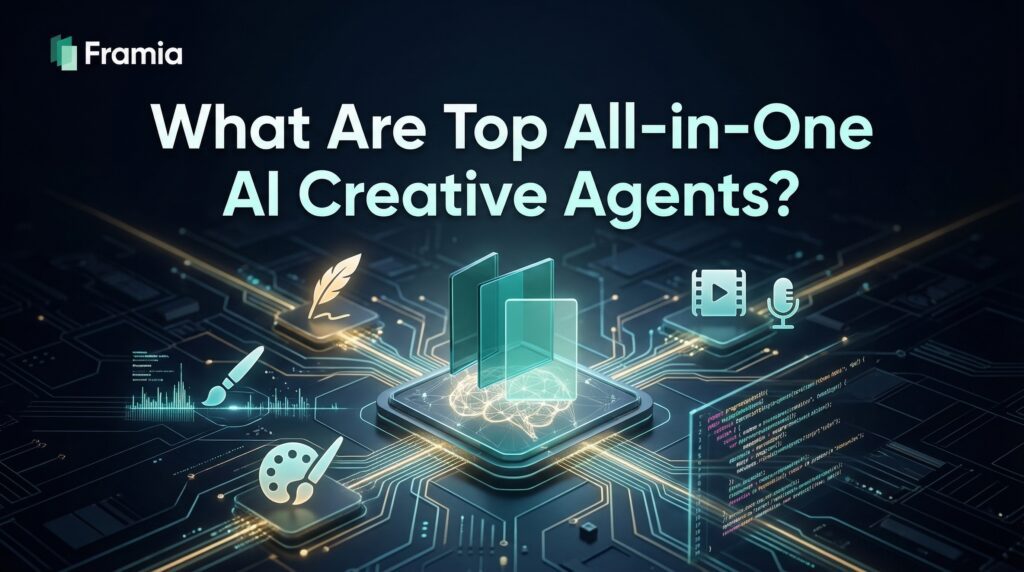
All-in-one AI creative agents combine several tasks into one. Moreover, top all-in-one AI creative agents streamline workflows by integrating writing, design, and marketing tools in a single platform.
This lets you go from an idea to ready assets without switching tools. You can create content, design, and even do basic marketing in the same place.
This is important because a single tool might only do one thing, like write a caption. But an agent-based system keeps going, remembers your goal, and helps you complete tasks with fewer steps.

Platforms like Framia Pro take this concept further by offering specialized AI agents for video, ads, social media, and branding, allowing creators to move from idea to publish-ready content in a single workflow.
Definition and Overview
An “agent” is software that follows your instructions and produces useful options. You can start with a campaign idea, ask for ad angles, and then generate creative options that match your message.
When looking for the best AI creative software, find platforms that offer a guided workflow. The best ones help you work fast while keeping your strategy and brand voice consistent.
Key Features
Most teams want to work with text and images together, and sometimes audio or video. Using top all-in-one AI creative agents allows seamless creation across multiple media types without switching apps.
This makes AI content creation more practical. You can draft copy, shape visuals, and adjust formats in one flow.
Brand controls are also key. With brand kits, tone guidance, and reusable templates, you spend less time fixing style issues. This lets you approve work that already sounds like your brand.
- Multimodal creation for text plus images, with quick variations for different channels
- Brand controls like brand kits, tone settings, and templates you can reuse
- Collaboration through shared projects, comments, and version history
- Exports sized for social posts, presentations, email, and common ad formats
- Integrations with cloud drives and team tools to reduce copy-paste work
- Safety and governance such as roles, permissions, and basic content policies
For example, tools like Framia Pro use dedicated agents for tasks like short-form videos, ad creatives, and branding, which makes content production more structured and scalable.
To judge the best AI creative software, use clear criteria. Look at output quality, control over tone and structure, iteration speed, ease of use, and support for campaign steps.
Evaluating the Best AI Creative Software
| What you evaluate | What “good” looks like in daily use | What slows you down |
|---|---|---|
| Output quality | Clean drafts with clear claims, strong structure, and fewer rewrites for your audience | Generic language, off-brand phrasing, or facts that need heavy checking |
| Controllability | Easy edits with tone controls, templates, and consistent formatting across assets | Random shifts in voice, weak prompts needed for simple changes |
| Speed | Fast drafts and fast variations for testing, without long wait times | Slow generation, laggy editing, or clunky asset management |
| Ease of use | A guided workflow that matches how you plan, draft, review, and publish | Too many steps, confusing menus, or unclear version tracking |
| Workflow support | From concept to ads to landing page outline to creative variants in one connected project | Tool switching, broken context, and exports that require extra rework |
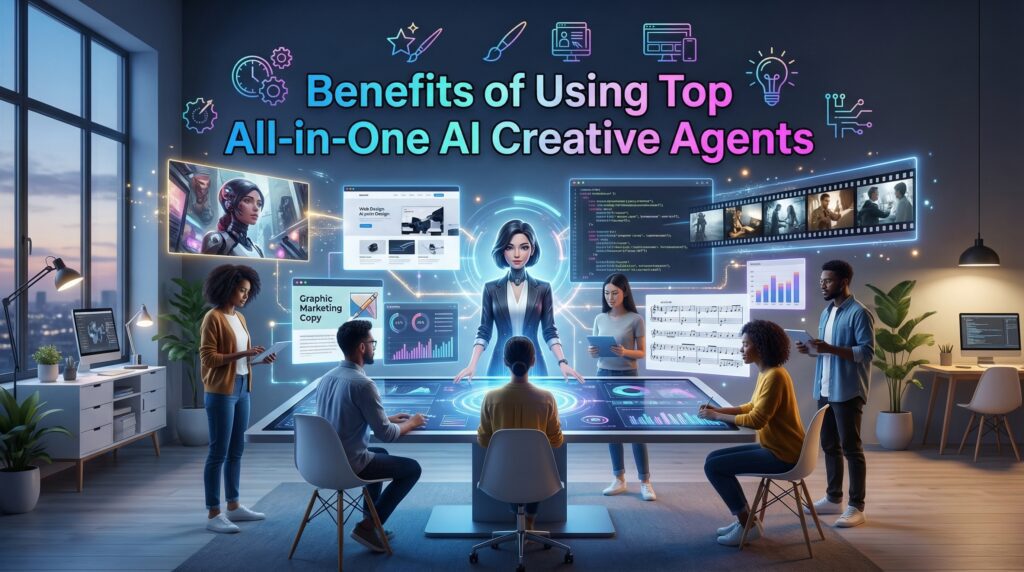
Benefits of Using Top All-in-One AI Creative Agents
When your content calendar is full, AI creative agents can help. These top all-in-one AI creative agents boost productivity by automating repetitive tasks and maintaining brand consistency.
They make it easier to go from idea to finished product. You can think of them as a partner that keeps your brand’s voice consistent, helping you create more content.
They start you off with a draft and different versions. This makes it easier to work together. Your team can give feedback on something real, not just an idea.
Enhanced Efficiency
AI can help with first drafts and quick rewrites. Furthermore, top all-in-one AI creative agents enable faster content iteration and easier collaboration across teams.
This is great for creating lots of content like emails and ads. You can also change the look of your content for different places without starting over.
Working faster happens when you use clear briefs and templates. Brainstorms are better, and you need fewer rounds of approval. This means you spend more time choosing the best idea and less on fixing the basics.
If you already use AI for analytics, creative agents can help with content. This keeps your creative and data insights together. So, you can make changes faster based on what works.
Cost-Effective Solutions
Saving money is simple: fewer subscriptions and less time switching between apps. Choosing top all-in-one AI creative agents reduces overhead by consolidating multiple tools into one efficient platform.
Using one place for copy and design edits saves time. This also means fewer mistakes when everyone works from the same place.
Small teams can do more without needing more people. AI tools help keep quality up while you make more content. This is good for busy times and ongoing campaigns.
| Cost lever | How it saves you money | What to put in place | Example use |
|---|---|---|---|
| Consolidated subscriptions | You replace several single-purpose apps with one creative hub. | Pick a tool that covers copy, variations, and basic asset edits. | Create ad copy sets and social captions in one workspace. |
| Less context switching | You spend fewer hours moving between docs, design files, and chat threads. | Use shared templates, naming rules, and a single request intake form. | Turn one campaign brief into email, paid social, and landing page copy. |
| Reduced rework | You avoid late-stage rewrites when drafts start on-brand. | Lock brand guidelines, claims rules, and required disclaimers in the process. | Generate compliant product descriptions with consistent tone and structure. |
| Higher output per person | You increase throughput without immediately hiring more staff. | Set review steps and clear owners for final edits and approvals. | Produce weekly promo graphics and copy variants for A/B tests. |
The best return on investment comes from using a tool with a clear process. Clear briefs and guidelines keep quality high, even when you work fast. This way, your team can focus on making decisions, not fixing basics.
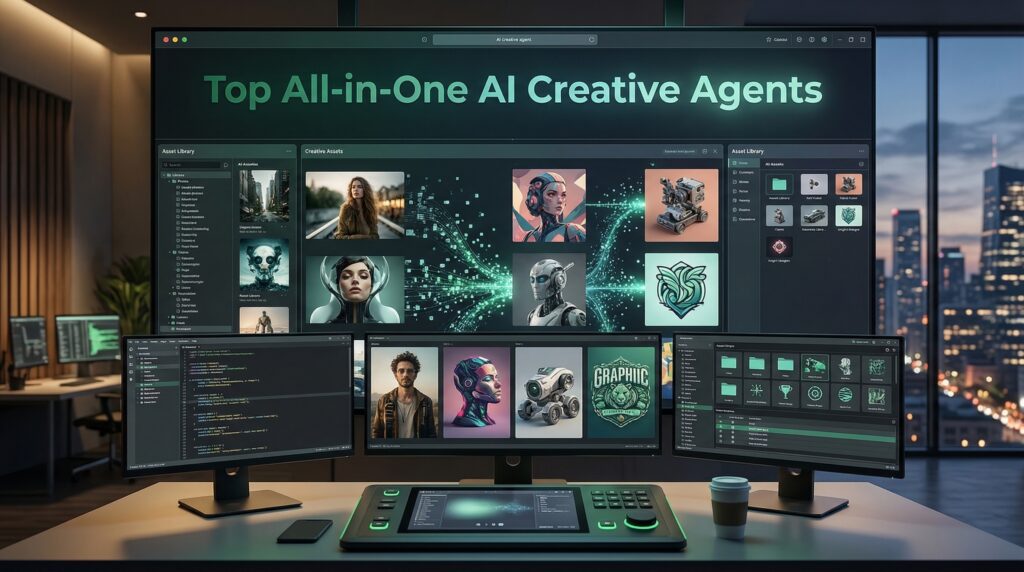
Top All-in-One AI Creative Agents
When looking at top all-in-one AI creative agents, think about how you work. Selecting the right top all-in-one AI creative agents depends on your workflow needs and integration preferences. Some tools are built into design apps, others focus on copy and campaigns.
Others connect content to your marketing system. Seeing them as AI-powered creative agency solutions helps you judge them by how well they fit your workflow.
Not all platforms in this space are built the same. Some tools like Canva and Adobe focus on design-first workflows, while newer platforms like Framia Pro use an agent-based approach, where each task (video, ads, social, branding) is handled by a specialized AI agent.
Overview of Leading Options
Adobe Creative Cloud with Firefly is great for those who want AI in familiar tools. Many users find top all-in-one AI creative agents like Adobe and Canva offer the best balance of power and ease.
It speeds up concepting, edits, and asset variations, all within a design-native environment.
Canva is perfect for quick, template-driven production. It’s great for making social posts, one-pagers, and team reviews fast and polished.
Jasper and Copy.ai are strong in marketing workflows. They’re good at drafting campaigns, creating ad variations, and helping with brand voice. This makes them useful for content teams that publish often.
HubSpot AI features are ideal when content is tied to CRM, email, and reporting. If you want your drafts, approvals, and campaign steps to be closer to your customer data, this approach can help.
Newer platforms like Framia Pro are also emerging, focusing on agent-based workflows where each content type (video, ads, social, branding) is handled by a specialized AI module.
Comparing Features and Pricing
Pricing varies by plan, feature tier, or usage limits like credits. Therefore, evaluating top all-in-one AI creative agents includes considering cost, features, and scalability.
The best comparison is based on your output. Consider how many assets you produce, how many people work on them, and how strict your brand rules are.
| Tool category | Examples | Best fit for your workflow | What to compare | Common pricing pattern |
|---|---|---|---|---|
| Suite (design-first) | Adobe Creative Cloud + Firefly, Canva | You need visuals, exports, and quick iterations in one place | Asset formats, brand kits, template controls, collaboration, version history | Per-seat tiers plus feature tiers; some AI features use credits |
| Campaign (copy-first) | Jasper, Copy.ai | You produce ads, landing pages, emails, and social copy at high volume | Brand voice settings, reusable frameworks, approval flows, team workspaces | Per-seat plans with limits by user, workspace, or usage |
| Platform (marketing ops-first) | HubSpot AI features | You want content connected to CRM, campaigns, and performance tracking | Integration depth, permissions, publishing steps, analytics, lifecycle support | Bundle-based tiers; AI capabilities vary by package and seat count |
When comparing top all-in-one AI creative agents, focus on brand controls, collaboration, and content lifecycle support. The packaging may change, so choose AI-powered creative agency solutions that fit your team’s workflow.
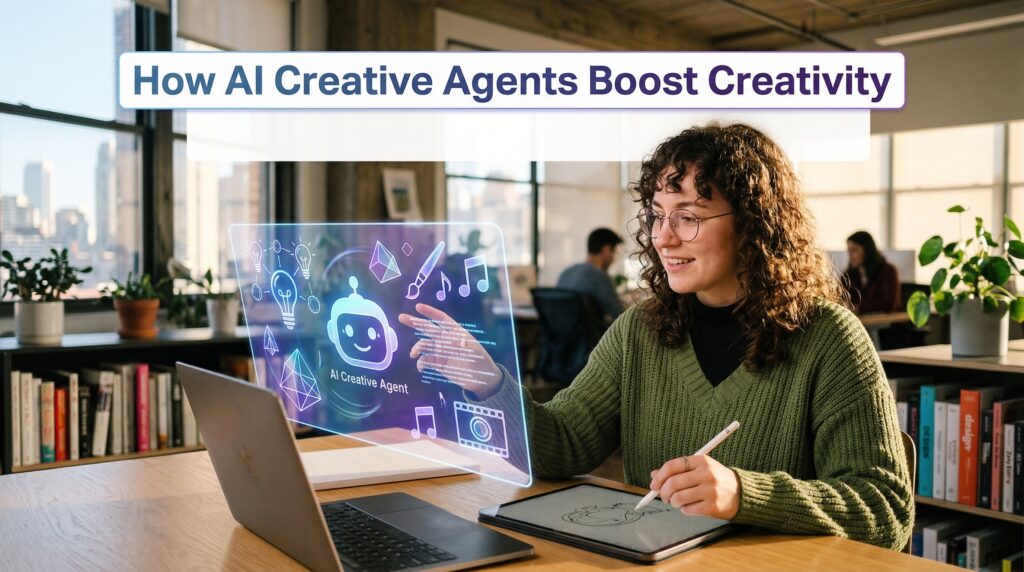
How AI Creative Agents Boost Creativity
An all-in-one creative agent doesn’t replace your taste. Instead, top all-in-one AI creative agents amplify your creative vision by generating diverse ideas quickly.
It gives you more ideas faster. With AI, you can explore new directions while keeping your brand and audience in mind.
AI design and branding tools help keep your look and voice consistent. This means fewer drafts that are almost right and more that fit perfectly from the start.
Idea Generation Assistance
Stuck on a blank page? Ask for ideas, hooks, taglines, and content pillars. Using top all-in-one AI creative agents helps you explore multiple creative directions efficiently.
Use past campaigns and your brand voice as inputs. The better your inputs, the closer your outputs will be to your brand.
AI is great for exploring your brand. It can create mood-board directions, naming routes, and messaging hierarchies. You can also get multi-variant ad concepts for A/B testing.
| Creative task | What you provide | What you get back | How you keep it on-brand |
|---|---|---|---|
| Mood-board directions | Audience, product benefits, 3–5 brand adjectives, 2 competitor examples | Visual themes, texture and color cues, photography style, do/don’t notes | Lock brand colors, avoid banned imagery, match tone to your category |
| Naming explorations | Positioning statement, key differentiator, word styles you like or hate | Name lists by style (descriptive, evocative, compound), plus short rationales | Filter by pronunciation, trademark risk prompts, and cultural fit checks |
| Messaging hierarchy | Primary promise, proof points, objections, required claims | Headline ladder, subhead options, benefit bullets, CTA variations | Keep required disclosures, match reading level, maintain brand voice |
| Multi-variant ad concepts | Offer, target persona, channel, constraints (character limits, policy rules) | Several concept “families” with hooks, headlines, and visual prompts | Use approved terms, avoid sensitive targeting, stick to brand POV |
Streamlining the Creative Process
With AI, one brief can lead to a repeatable process. Moreover, top all-in-one AI creative agents support coordinated content creation across channels. It supports creating coordinated content for various platforms. This way, your core message stays intact.
Repurposing content becomes faster. AI helps turn a blog into a script, and a script into captions. It keeps your message consistent across different formats.
Design-wise, AI assists in creating consistent layouts and applying brand colors. It’s essential to be clear about your goals and what “on-brand” means to your team.
User Experiences and Testimonials
Teams start with small steps, not big dreams. They face clogged pipelines, too many channels, and slow reviews. This makes AI content creation hard to scale.
Teams with smoother days treat the tool as a shared space. They choose one place and follow clear rules. This builds trust in the AI creative software.
Case Studies of Successful Implementations
Start by mapping your bottlenecks. List what slows you down, like repeated briefs and scattered feedback. Then, pick one place for drafts, comments, and final files.
Next, add structure. Set brand guidelines, templates, and a short approval path. Define roles for generating drafts, editing, and approving. This makes AI content creation useful.
| What you measure | How you measure it | What “better” looks like in practice |
|---|---|---|
| Production speed | Time from brief to first shareable draft | Same-day drafts for social, and faster first passes for email and landing pages |
| Usable variants | Count of on-brand options that pass internal review | More test-ready headlines, hooks, and CTAs without extra meetings |
| Engagement lift | Performance change after quicker A/B testing cycles | More frequent testing, with learnings applied to the next batch |
| Revisions | Number of review rounds per asset type | Fewer back-and-forth edits because tone, claims, and format are pre-set |
| Time saved | Minutes saved per asset (ad, email, blog intro, design resize) | Writers spend more time on ideas; designers spend more time on polish |
Good outcomes come from basics: faster throughput, fewer edits, and clear ownership. The best AI creative software works best with a steady process, not improvisation.
Feedback from Creative Professionals
Writers like fast outlining and variant generation. But, they need tight tone control. Designers prefer quick drafts and simple layout experiments.
Marketing leads value consistency and collaboration. They see better results with shared inputs, templates, and approval steps. The best AI creative software scales messages well without mess.
Trustworthy testimonials are specific. They detail what the tool replaced, what improved, and what needed human review. This clarity makes your AI content creation story believable to your team.
Integrating AI Creative Agents into Your Workflow
Adding an AI creative agent to your work is easier when you treat it like a team member. Start small, keep your standards clear, and you’ll get reliable results. This way, you can compare different tools without disrupting your workflow.
Before making any changes, map out your current process from start to finish. Identify where you wait the longest and where edits pile up. These slow points are the best places to test AI tools first.
Steps for Seamless Adoption
- Audit the workflow: brief → draft → design → review → publish, then circle the biggest delays and repeat errors.
- Pick one pilot: one campaign or one channel with clear goals, like ad click-through rate, email sign-ups, or qualified leads.
- Set up brand assets: tone rules, approved terms, “do-not-say” words, visual guidelines, and ready-to-use templates.
- Define review rules: who approves headlines, who checks claims, where final edits live, and what always needs a human pass.
- Save prompt frameworks: reusable brief formats your team can copy, so results stay consistent across projects.
Documenting these steps helps reduce back-and-forth and protects your brand voice. AI-powered creative agency solutions are great at scaling output while keeping quality high.
Tips for Maximizing Effectiveness
- Go brief-first: spell out the audience, offer, proof points, constraints, and CTA before you ask for copy or concepts.
- Standardize versions: v1 draft, v2 compliance edits, v3 final, so nobody works from the wrong file.
- Build a content system: pillar topics → weekly spinoffs → repurposed variants for ads, email, and social.
- Track performance: test hooks, headlines, and images, then keep what wins and drop what doesn’t.
| Workflow checkpoint | What you set up | What you measure | Why it helps |
|---|---|---|---|
| Brief intake | One-page brief with audience, offer, proof points, CTA, and constraints | Time from request to approved brief; revision count | Cleaner inputs reduce rewrites across digital marketing AI tools |
| Draft creation | Prompt templates for emails, landing pages, and paid social variations | Draft-to-approval time; number of stakeholder edits | Repeatable structure keeps output aligned with your message |
| Design handoff | Brand kit, layout rules, and reusable formats for key channels | Design turnaround time; rework rate | Fewer mismatches between copy and creative |
| Review and compliance | Approval map, claim-check checklist, and a single place for final edits | Compliance fixes per asset; missed requirements | Human review stays focused on risk, not basic cleanup |
| Publish and learn | A/B plan for headlines, hooks, and visuals; shared results log | CTR, CVR, CPA, and engagement by variant | AI-powered creative agency solutions work best when you feed back real outcomes |
Potential Drawbacks of Top All-in-One AI Creative Agents
All-in-one creative agents can speed up your work. But, this speed might hide weak spots. If you use top AI marketing tools without clear inputs, your work might feel safe but plain.
This issue is clear in AI design and branding. Without specific brand cues, the system uses common patterns. You might get clean work, but it could lack the unique voice and tone of your brand.
Limitations to Consider
Generic copy is a common problem. To avoid it, use past campaigns, approved phrases, and real examples. Without these, AI tools often use broad claims and familiar hooks.
Visual consistency can also be a challenge. Even with strong AI design and branding, your team might need manual fixes. This ensures fonts, colors, and spacing are consistent across assets.
“All-in-one” can mean “mostly in one place.” Integrations vary, so you might need to export and import files. This can slow down review cycles and cause confusion.
Team governance is another issue. If permissions are loose, brand compliance can get messy. Unclear approvals can lead to accountability problems.
| Common constraint | What you may notice | What helps you stay on track |
|---|---|---|
| Generic messaging | Copy sounds polished but interchangeable | Use a brand brief, approved examples, and a banned-phrases list before you generate |
| Inconsistent visuals | Colors and layouts shift between assets | Lock templates, set style tokens, and do a quick manual pass for alignment |
| Uneven integrations | You stillexport/import for design or analytics steps | Map your workflow first, then test each handoff with a real campaign file set |
| Governance gaps | Unclear approvals and off-brand variants in circulation | Set roles, permissions, and a single review owner for each deliverable |
Managing Expectations
Think of AI as a production accelerator, not a full replacement for strategy or taste. Top AI marketing tools can help you move faster, but they can’t own your positioning, your offer, or your final quality bar.
You protect quality by writing simple brand rules and keeping them easy to find. This includes voice, key messages, and do-not-say claims. For AI design and branding, it also includes logo spacing, color values, and image tone.
Human review matters most when you make claims or handle sensitive topics. You should check for accuracy, compliance, and context. A single source of truth for messaging helps your team avoid drift across channels.
To lower adoption risk, start with a pilot. Measure turnaround time, revision rates, and asset consistency. Then expand scope only when the results hold up under real deadlines.
Future Trends in AI Creative Solutions
The next AI tools will feel like a partner, not just a gadget. They will help turn ideas into polished assets, keeping your brand’s voice intact. As AI software improves, it will focus on control, consistency, and speed across different platforms.
Emerging Technologies
Multimodal generation is getting better, allowing work across text, images, audio, and video. You’ll also get smarter tools for keeping your brand consistent, like style guides that work across campaigns. This makes AI solutions more reliable at scale.
Editing is becoming more precise. Expect better layers, timelines, and prompt controls, similar to Adobe Photoshop and Premiere Pro. The best AI software will follow your direction more accurately.
Workflow features are moving toward measurable output. You’ll see automated variant generation for A/B tests, faster localization, and tighter team collaboration. This includes support for Slack, Microsoft Teams, and Google Workspace.
| Trend | What changes in your workflow | What to watch for |
|---|---|---|
| Stronger multimodal generation | You move from one brief to many asset types, faster | Quality controls that keep scenes, characters, and tone consistent |
| Brand consistency systems | You reuse approved language, colors, and layouts across teams | Guardrails for claims, legal lines, and regulated categories |
| Advanced editing controls | You spend less time re-rolling and more time refining | Non-destructive edits, version history, and clear change tracking |
| Marketing stack integration | You push assets into campaigns with fewer handoffs | Clean connections to tools like HubSpot, Salesforce, and Google Analytics |
| Automation for testing and localization | You generate variants and regional edits in minutes | Translation quality, cultural fit, and on-brand terminology |
Predictions for the Creative Industry
Your role is evolving, focusing more on creative direction and feedback. AI tools will help you refine ideas, making your taste and judgment key. This shift emphasizes the importance of your input.
Teams that set clear standards will work faster. You’ll define prompts, review steps, and brand rules. The best AI software rewards disciplined teams with cleaner outputs and reliable testing.
Brand stewardship will become more data-driven. You’ll adjust messaging and visuals based on performance, not just looks. AI helps protect your brand while scaling content efficiently.
Final Thoughts on Top All-in-One AI Creative Agents
All-in-one AI creative agents are like a shared workspace for words, visuals, and tasks. You give a clear brief, and the system helps you draft, revise, and ship assets faster. The real win is not just novelty. It’s the repeatable output you can use across channels.
In day-to-day work, the biggest benefits are speed, scale, and consistency. Choosing top all-in-one AI creative agents can transform your content production with efficiency and quality.
You move from one-off drafts to a steady flow of on-brand copy, layouts, and variations. To compare the top all-in-one AI creative agents, focus on your main bottleneck first.
Then confirm you can set brand rules, review changes, and collaborate with your team without friction.
Integration works best when it fits your habits, not when it forces a new process. The strongest setups usually include shared prompt templates, approval steps, and a clean handoff to your existing tools. You’ll feel it when it clicks: fewer context switches, fewer rewrites, and fewer “final-final” versions.
Your best next step is a small pilot with one real campaign. Track time saved, output quality, and performance, then document the prompts and checklists that worked. If the results hold, expand to other formats and channels at your pace. You can start small and get meaningful gains.
If you’re exploring newer AI creative platforms, tools like Framia Pro are worth testing, especially if you want a structured, agent-based approach to content creation.
FAQ
What does “all-in-one” mean for AI creative agents in real marketing work?
What are all-in-one AI creative agents, and how are they different from single-purpose generators?
What makes a tool an “agent” instead of just an AI writer or image generator?
Which key features should you expect from the best AI creative software?
How do AI creative agents improve speed when you’re on a tight deadline?
Are all-in-one AI-driven creative solutions cost-effective for small teams?
Which top all-in-one AI creative agents are commonly used in U.S. marketing teams?
How should you compare pricing for top AI marketing tools without getting stuck on confusing tiers?
How can an all-in-one AI creative agent help you generate stronger ideas?
What’s a practical way to turn one brief into multi-channel campaign assets?
What does a realistic adoption plan look like for AI-powered creative agency solutions inside your team?
What are the most common drawbacks of top all-in-one AI creative agents?
How do you manage quality and brand safety when using AI content creation tools?
What should you measure in a case-study-style evaluation of AI-driven creative solutions?
What future trends are shaping AI design and branding tools?
 20
20
 25
25
 33
33