

Ever felt your heart sink when a reader clicks away too soon? It’s frustrating to see your hard work ignored because the flow felt choppy. You deserve to keep their attention from start to finish. Using effective composition methods, like transition words in blog writing, turns your message into a compelling story. It’s about building a bridge between your thoughts to improve clarity. This way, your visitors will never feel lost or confused while exploring your page.
We share key publishing tips to help sharpen your unique voice and improve readability. These small changes make every sentence feel natural and polished. You’ll learn to guide people through your ideas with professional ease.
Mastering transition words in blog writing gives your content the structure it needs. It adds a professional touch that keeps your audience coming back. Let’s start improving your craft today.
Key Takeaways
- Understand how flow impacts reader retention and engagement.
- Discover how to connect isolated thoughts for better clarity.
- Utilize specific phrases to guide the audience’s eye seamlessly.
- Enhance overall polish and professional appeal of your work.
- Boost your confidence through improved technical composition.
- Learn to maintain a steady pace throughout long articles.
What Are Transition Words in Blog Writing and Why They Matter?
Transition words are the unsung heroes of effective writing. They are very important. They help connect ideas, make things clear, and improve how your blog posts flow. Mastering transition words in blog writing is essential for creating content that feels natural and keeps readers engaged from start to finish.


Definition of Transition Words
Transition words are words or phrases that link ideas, sentences, or paragraphs. They make your writing clear and easy to follow. They act as bridges, smoothly moving from one idea to the next.
Some common examples of transition words include:
- additive transitions: also, further, more
- adversative transitions: but, yet, on the other hand
- causal transitions: so, then, as a result
- sequential transitions: first, next, last
Importance in Writing Clarity
Using transition words is key for clear writing. They help link your ideas, making it easier for readers to follow your message.

Here are some key benefits of using transition words:
- Improved coherence: Transition words link your ideas, creating a cohesive flow.
- Enhanced readability: They make your content easier to read and follow.
- Better engagement: They guide readers, keeping them interested and engaged.
To make effective transitions, pick the right transition words for your context. A good transition words list is very helpful for bloggers and writers.
Different Types of Transition Words in Blog Writing
Transition words are not all the same. They serve different roles in your writing. Knowing these roles helps make your blog flow better and connect your ideas well.
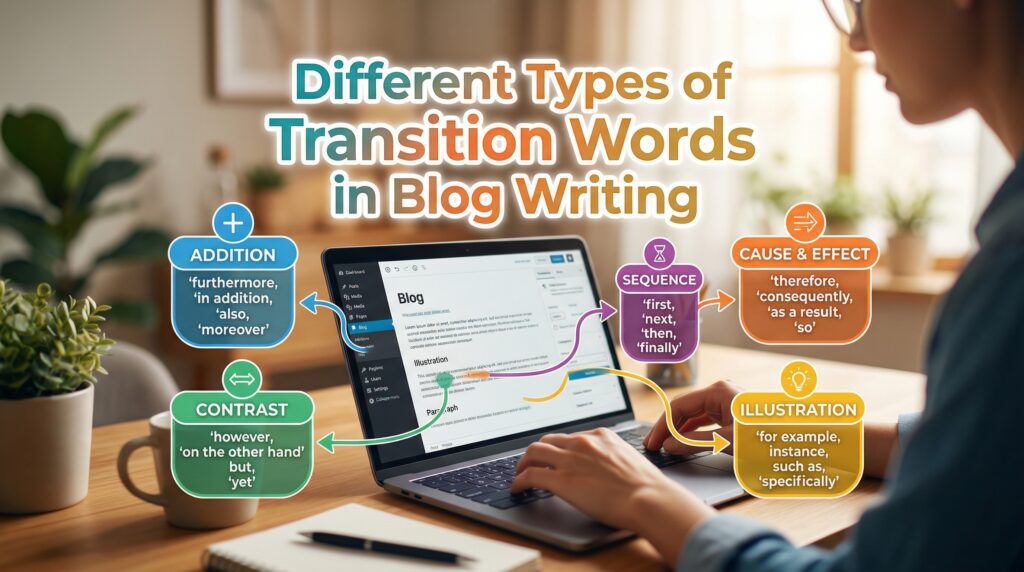
Additive Transitions
Additive transitions add more info or support a point. Words like “additionally,” “furthermore,” and “moreover” fall into this category. They help expand on an idea, making your writing richer.

For example, talking about a healthy diet? You could use “furthermore” to list more benefits: “A healthy diet not only improves your overall well-being; furthermore, it can also boost your energy levels.”
Adversative Transitions
Adversative transitions show contrasts or oppositions. Words like “nevertheless” and “despite this” are examples. They’re key for showing different sides of an argument.
For instance: “While some say remote work is less productive, on the other hand, others see it as a chance to balance work and life better.”
Causal Transitions
Causal transitions explain cause and effect or consequences. “Therefore” and “as a result” are examples. They clarify how ideas or events are connected.
For example: “The company put a lot into renewable energy; as a result, they cut their carbon footprint a lot.”
Sequential Transitions
Sequential transitions show the order of events or ideas. “Firstly” and “next” are examples. They help readers follow your text smoothly.
For instance: “To make a cake, firstly preheat the oven to 350°F. Next, mix the ingredients. Lastly, bake the batter in a greased pan.”
| Type of Transition | Examples | Purpose |
|---|---|---|
| Additive | Adding, Further, In addition, More | Add info or support a point |
| Adversative | But, On the other hand, Nevertheless, Despite | Show contrast or opposition |
| Causal | So, Then, Because, As a result | Explain cause and effect or consequence |
| Sequential | First, Next, Then, Last | Show order or sequence |
“The key to successful writing is clarity, and transition words are the bridges that connect your ideas, making your writing flow smoothly.”
Learning about different transition words can greatly improve your blog. It makes your writing clearer and more engaging for readers.
How Transition Words Improve Flow
Transition words are key to keeping your readers interested. They connect your ideas, making your writing smooth and easy to follow. Using the right transition words in blog writing ensures your ideas flow logically, helping readers stay focused and understand your message better. Using them well can make your blog posts more enjoyable to read.
Guiding Reader’s Journey
Transition words help guide your readers through your blog. They show the direction of your argument or story. Words like “firstly,” “next,” and “first” help show how ideas follow each other.
These words also control the pace of your story. They can slow down or speed up the reader’s experience. For example, “meanwhile” can introduce a new idea, adding depth to your topic.
Creating Logical Connections
Transition words are essential for linking ideas smoothly. They make your blog easy to follow. Words like “additionally” or “furthermore” expand on your ideas.
Words like “therefore” or “consequently” show cause-and-effect. They make your ideas flow logically, keeping your readers engaged.
To keep your writing flowing, mix up your transition words. A thesaurus or writing tool can help find new words that fit your style.
Enhancing Coherence with Transition Words in Blog Writing
To make your blog easier to read, it’s key to know how transition words help with coherence. Coherence means your ideas flow smoothly, making your content clear and fun to read. Effective use of transition words in blog writing is one of the best ways to enhance coherence and create a seamless reading experience.
Transition words act like glue, connecting your sentences and paragraphs smoothly.

Building Paragraph Unity
A well-organized paragraph is the base of clear writing. Transition words help tie your ideas together, making your points easy to follow. For example, words like “additionally” and “furthermore” link new info to what you’ve already said.
Here are some tips for using transition words to build paragraph unity:
- Use additive transitions to add more information or examples.
- Employ causal transitions to show cause and effect.
- Utilize sequential transitions to indicate a sequence of events or steps.
Linking Ideas Across Sections
Transition words are not just for paragraphs; they’re also key for connecting ideas between sections. They keep your content flowing and your readers interested. For instance, phrases like “in conclusion” or “moving forward” help guide your readers to new ideas or sections.
Some effective strategies for linking ideas across sections include:
- Using summary transitions to recap what has been discussed before moving on to a new topic.
- Employing contrastive transitions to highlight differences between ideas or sections.
- Incorporating conclusive transitions to wrap up your discussion and lead into a final thought or call to action.
By mastering transition words, you can make your blog writing clearer and more enjoyable for your readers.
Transition Words in Blog Writing: Common Mistakes to Avoid
To make your blog better, it’s key to know the mistakes to steer clear of with transition words. These words are great for making your writing smooth and clear. But, if used wrong, they can mess up your message.
Understanding how to balance transition words in blog writing helps you avoid overuse and keeps your content natural and engaging.
Overusing Transition Words
Many bloggers make the mistake of using too many transition words. These words are vital for linking ideas, but too much can make your writing seem fake. You should aim for a balance that keeps your writing natural.
For example, starting every sentence with a transition word gets boring fast. Mix up your sentence structure. Use transition words only when they’re really needed to guide your reader.
Inappropriate Context Usage
Another big mistake is using transition words in the wrong places. This can confuse your readers and mess up your writing’s flow. For instance, using a causal transition word like “therefore” in a story that doesn’t have cause and effect can be confusing.
To avoid this, understand the meaning and function of each transition word. Make sure the transition word you pick shows the right connection between your ideas. This keeps your blog post clear and logical.
Tips for Incorporating Transition Words
To make your blog writing better, learning to use transition words is key. These words are not just extra; they are powerful tools that make your blog easier to read.
Using transitional phrases well involves a few important strategies. The aim is to make them feel natural and improve the reader’s experience. Practicing the use of transition words in blog writing will help you find the perfect rhythm and flow for your unique style.
Natural Placement
Where you place transition words is very important. You want them to fit naturally and not disrupt your writing. This means avoiding places that feel forced or awkward.
For example, starting a sentence with “howver” or “in addition” can be great. It signals a change in your argument or adds more info. The trick is to use these words naturally to make your writing clearer.
Varying Word Choice
Varying your transition words is also key. Using the same words too much can make your writing dull. Try mixing it up with different phrases to express the same idea.
If you’re adding more to a point, use “in addition,” “furthermore,” or “moreover.” Varying your words keeps your writing fresh and engaging. This helps keep your readers interested and improves your blog’s flow.
Examples of Effective Transition Words
To improve your blog writing, mastering transition words is key. These words are not just fillers; they connect your ideas smoothly. We’ll look at some great introductory and concluding transition words to boost your writing.

Top Choices for Engaging Introductory Phrases
A strong opening phrase can grab your reader’s attention. Here are some effective transition words and phrases to start with:
- But, it’s worth noting that…
- Also, we have another point to share…
- At the same time, consider this aspect…
- First, let’s look at…
- Notably, a key point is…
These phrases set the tone and smoothly lead into your main content.
Powerful Concluding Transition Words
Ending your blog post well is as important as starting it. The right words can summarize your main points and leave a strong impression. Here are some effective concluding transition words:
- In conclusion, it’s clear that…
- Ultimately, the main point is…
- To sum up, we’ve learned that…
- In the end, what’s most important is…
- Overall, the evidence points to…
Using these words can help you conclude your blog post effectively and reinforce your message.
By adding these transition words to your writing, you can make your blog posts flow better. This makes them more enjoyable for your readers.
Analyzing Famous Blog Posts
Looking at top blog posts shows how important transition words are. They make reading easier. By studying how famous bloggers use these words, you can learn to write better.
Transition words are not just extra words. They help readers follow your content. This makes your writing more engaging and clear. Let’s see how famous bloggers use transition words.
Transition Words in Popular Blogs
Popular blogs use transition words to link their ideas smoothly. For example, The Huffington Post and ProBlogger often use these words to connect their paragraphs.
Here’s a table showing common transition words used in popular blogs:
| Transition Type | Example Words | Blog Example |
|---|---|---|
| Additive | Adding to that, more, also | “Also, the data shows a big increase in engagement.” |
| Adversative | But, yet, on the other hand | “Yet, the results were not as we thought.” |
| Causal | So, because of this, as a result | “So, the conclusion is backed by the evidence.” |
| Sequential | First, next, last | “First, we need to understand the situation.” |
How They Enhance Reader Experience
Using transition words wisely makes your content flow better. This makes it easier and more fun to read. It helps readers understand your point or story.
For instance, words like “additionally” or “moreover” add strength to your argument. They bring in more evidence or details. On the other hand, words like “but” or “nevertheless” introduce a different view. This makes your discussion richer.
By using different transition words, bloggers can make their writing clearer and more engaging. This keeps their readers interested and coming back for more.
Tools for Finding Transition Words
To improve your blog writing, using tools to find transition words is key. These tools suggest better phrases and words. They make your writing flow better and clearer.

Online Thesauruses
Online thesauruses are great for finding synonyms and transition words. They help you use different words and avoid repeating yourself. This makes your writing more interesting. You can find them on websites like Thesaurus.com and in many online dictionaries.
Just type in a word or phrase in an online thesaurus. It will give you a list of alternatives. For instance, if you need something other than “howver,” you might find “on the other hand,” “nevertheless,” or “in contrast.”
| Transition Type | Example Words/Phrases | Use Case |
|---|---|---|
| Additive | Adding to that, more, also | Adding more information or details |
| Adversative | But, yet, on the other hand | Showing a difference or contrast |
| Causal | So, because of this, as a result | Showing cause and effect |
| Sequential | First, next, last | Showing order or sequence |
Writing Assistant Tools
Writing assistant tools do more than just suggest synonyms. They analyze your text and offer suggestions for improvement. Tools like Grammarly and Hemingway Editor can spot where your writing could use better transitions.
“Good writing is clear thinking made visible.” – Bill Wheeler
These tools give you feedback as you write. They suggest changes to make your writing clearer and easier to read. By using these tips, you can make your blog posts more enjoyable to read.
- Grammarly: Checks grammar and spelling, and offers tips on sentence structure and word choice.
- Hemingway Editor: Makes your writing simpler by pointing out complex sentences and suggesting easier alternatives.
Practice Exercises for Mastery
To get better at using transition words in blog writing, practice is key. Doing targeted exercises can boost your writing’s flow and skill.
Fill-in-the-Blank Activities
Fill-in-the-blank activities are a great way to practice. They let you fill sentences with the right transition words. This makes your writing clearer and smoother. You can find these exercises online or make your own based on your blog topics.
Peer Review Techniques
Peer review is another helpful method. Share your blog posts with others and ask for feedback on transition words. This feedback can help you make your writing better and more connected. Regularly using peer review will improve your skill in using transition words.
Do Transition Words Affect SEO Rankings?
Search engines like Google do not directly measure the percentage of transition words in your article. There is no official ranking factor that checks whether you used 20% or 30% transition phrases.
However, transition words in blog writing can indirectly influence SEO. When used correctly, they improve readability, structure, and user experience — all of which help reduce bounce rate and increase time on page.
For specific guidance on what transition words are and how to use them effectively in your posts, Yoast’s guide on transition words explains both why they matter and how to apply them correctly in your content.
Proper use of transition words in blog writing not only enhances reader engagement but can also indirectly boost your SEO performance.
On the other hand, overuse of transition words can make your content sound robotic and unnatural. If every sentence begins with “Moreover,” “However,” or “Therefore,” the text may feel forced rather than helpful.
At the same time, using too few transitions can result in choppy, disconnected paragraphs that frustrate readers. The ideal approach is natural usage. Focus on clarity first — not percentages.
How Many Transition Words Are Too Many?
Many SEO plugins suggest that around 30% of your sentences should contain transition words. This is often called the “30% rule.”
While this guideline can be helpful, it should not be treated as an absolute standard. Tools like Yoast provide recommendations based on readability formulas, but they cannot fully evaluate tone, context, or writing style.
To see how many transition words your text contains, you can try free tools like this Transition Word Counter to analyze your content and adjust your usage naturally.
If you force transition words into sentences just to reach a green score, your content may start sounding mechanical. Natural rhythm always beats artificial optimization.
Instead of chasing a specific percentage, aim for smooth logical connections. If your content flows well when read aloud, you are likely using the right amount of transitions.
FAQ
What exactly are transition words in blog writing and why should I use them?
Transition words in blog writing are essential tools that help you connect ideas smoothly, making your content easier to read and more enjoyable.
Transition words are phrases that link ideas together in writing. They make your content flow smoothly. Using them turns a bunch of sentences into a story.
They help readers follow your thoughts easily. This makes your blog easier to read.
How do transitional phrases help improve blog flow?
Transitional phrases guide your readers through your content. They make your blog flow smoothly. This keeps readers interested and prevents them from leaving your page.
Can you give me a transition words list to help me get started?
Here’s a list to help you connect your ideas. Use “furthermore” or “in addition” to add more information. “Consequently” or “therefore” show cause and effect.
For contrast, try “nevertheless” or “on the other hand.” “Subsequently” or “meanwhile” are good for showing sequence.
What are the most common mistakes to avoid when using effective transitions?
Don’t overuse transition words. It can make your writing seem repetitive. Also, choose the right word for the context.
Always check if the transition fits the logical flow of your sentences.
How do I ensure my transition words sound natural and not forced?
Vary your transition words to sound natural. Use them in the middle of sentences, not just at the start. Try different words instead of repeating the same one.
Reading your blog aloud can help you see if it sounds natural and engaging.
Are there any digital tools that can help me master writing coherence?
Yes, tools like Grammarly and the Hemingway Editor can help. They highlight weak transitions. The Merriam-Webster online thesaurus offers better word choices to keep your blog interesting.
Do successful brands like HubSpot or Copyblogger use these techniques?
Yes, they do. HubSpot and Copyblogger use transitional phrases well. They keep readers engaged and interested in what they’re reading.
What is a good way to practice using transition words?
Try rewriting an old blog post without transitions. Then, add different transition words. You can also practice with fill-in-the-blank exercises or get feedback from other writers.
Getting feedback from others helps you see if your transitions are clear.