

Many content creators are asking the same question: how Google views AI content in today’s search landscape. With AI writing tools becoming more advanced and accessible, it is natural to wonder whether using them could hurt your rankings. The truth is that Google does not evaluate content based on how it was created, but on how helpful, accurate, and trustworthy it is.
Understanding how Google views AI content can help you use these tools strategically — without risking visibility or credibility. Instead of fearing automation, the smarter approach is learning how to align AI-assisted writing with Google’s quality standards.
Key Takeaways
- Search engines prioritize helpful, human-centric information over automation.
- Advanced tools should enhance, not replace, your original creativity and insight.
- Quality standards remain consistent regardless of the production method used.
- Building trust with your audience is more vital than ever for ranking.
- Algorithm updates focus on rewarding expertise and firsthand experience.
- Authenticity helps your brand stand out in a saturated digital landscape.
Understanding How Google Views AI Content
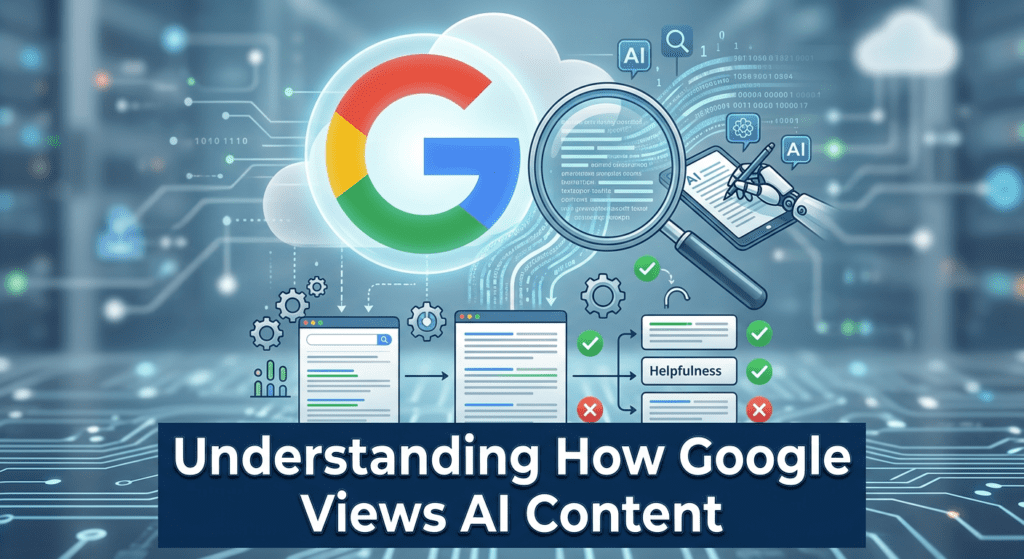
It’s key to know how Google checks AI content for a good content plan. Google looks at AI content in a detailed way. Moreover, understanding how Google views AI content helps you create strategies that align with search engine expectations. They focus on several important things to see if it’s good and useful.
The Importance of Quality

Google likes content that’s top-notch and really helps users. AI content needs to be well-researched, right, and fun to read. Here’s what makes AI content great:
- Relevance: It should match what the user is looking for and offer helpful info.
- Accuracy: The content must be true and current.
- Engagement: It should grab the user’s attention and make them want to interact.
Addressing Misinformation
AI content can sometimes share wrong info. Google is very strict about false or misleading content. Therefore, understanding how Google views AI content is essential to ensure your material maintains accuracy and trustworthiness. To stay clear of this, it’s important to:
- Check if the AI info is correct.
- Make sure the content comes from trusted sources.
- Keep the content fresh with the latest info.
Balancing Automation and Human Touch
AI can make creating content faster, but we also need human touch. Human input is key for:
- Making sure the content feels real and right for the audience.
- Adding a personal feel that connects with readers.
- Looking over and fixing AI content to stop mistakes or wrong info.
Additionally, knowing how Google views AI content can guide you in blending AI efficiency with authentic human creativity. By getting these points right, you can make AI content that Google likes and that helps your users.
Does Google Penalize AI-Generated Content?

The short answer is no — Google does not automatically penalize AI-generated content simply because it was created using artificial intelligence.
Google’s official guidance makes it clear that automation itself is not the problem. However, knowing how Google views AI content can prevent common pitfalls and ensure your content remains compliant with their policies.
What matters is whether the content is helpful, original, and created for users rather than search engines. If AI is used to produce spammy, low-quality, or misleading material at scale, then it may violate Google’s spam policies.
However, high-quality AI-assisted content that demonstrates expertise and serves real user intent is treated the same as human-written content.
In fact, Google has repeatedly emphasized that quality standards apply equally to all content, regardless of how it is produced. This means your focus should not be on hiding AI usage, but on improving accuracy, depth, and trustworthiness.

The real risk is not AI itself — it is publishing thin, repetitive, or purely SEO-driven material that lacks genuine value. When AI is used as a tool to support research, structure, or drafting — and combined with human insight and editorial review — it can strengthen your content strategy rather than harm it.
Ultimately, Google rewards usefulness, not production method.
If you want to evaluate how your content might be perceived, you can test it with an AI detection tool like JustDone to see how it analyzes AI-generated text patterns.
Algorithms: The Heart of Google’s Evaluation
Google’s algorithms are key to how it checks content. They look at many things to see if content is good and relevant. This helps decide how well it shows up in searches.
How AI Content is Ranked
Google looks at several things when ranking AI content. Therefore, understanding how Google views AI content is crucial for optimizing your material to meet these ranking factors. It checks if the content fits what the user is searching for. It also looks at how good the content is and how users interact with it.
To get a better idea of how AI content is ranked, let’s look at the main factors. These are:
- Content relevance: How well the content matches the user’s search query.
- Quality of content: The depth, accuracy, and usefulness of the information provided.
- User experience: Metrics such as engagement, bounce rate, and time spent on the page.
Impact of Search Algorithms
Search algorithms have a big effect on AI content. They keep getting better at understanding what users want and what makes good content.
| Algorithm Update | Impact on AI Content | Content Strategy Adjustment |
|---|---|---|
| Google BERT | Improved understanding of natural language, favoring content that better matches user intent. | Focus on creating content that naturally answers user queries. |
| Google MUM | Enhanced ability to understand complex queries, stressing the need for thorough content. | Develop in-depth content that covers topics thoroughly. |
Knowing about these updates helps content creators. They can change their strategies to make their AI content more visible and ranked higher.
The Role of E-A-T in AI Content
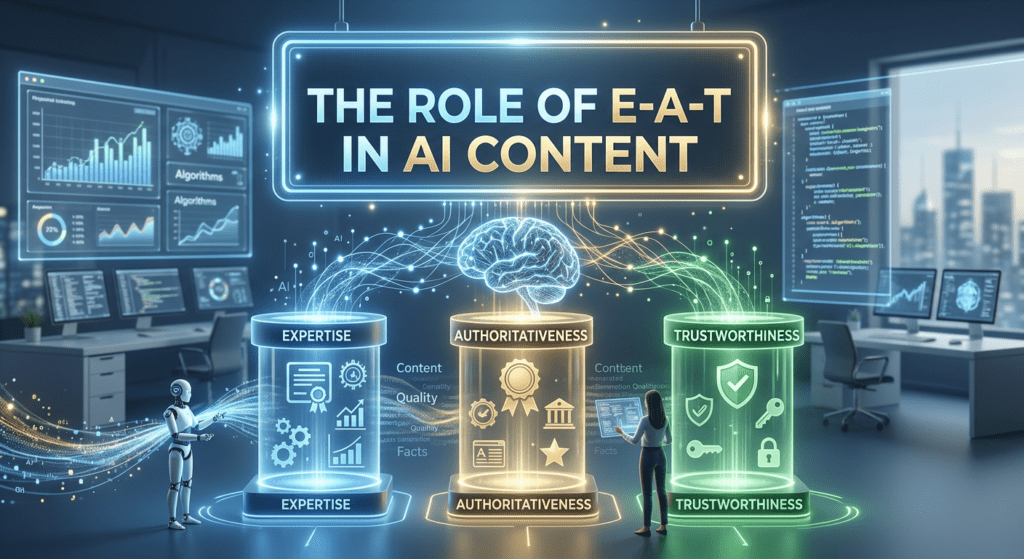
Exploring AI-generated content, it’s key to grasp E-A-T’s role in its credibility and Google ranking. E-A-T stands for Expertise, Authoritativeness, and Trustworthiness. Google uses these to judge content quality.
What is E-A-T?
E-A-T is Google’s way to check content’s trustworthiness. It has three main parts:
- Expertise: Shows the creator’s knowledge or skill.
- Authoritativeness: Looks at the creator’s or website’s reputation.
- Trustworthiness: Checks if the content is accurate, reliable, and clear.
For AI content, showing E-A-T is key. Consequently, knowing how Google views AI content in relation to E-A-T can help you focus on building trust and authority. It affects how Google sees the content’s quality and relevance.
Why E-A-T Matters for AI Generated Content
AI content might miss the personal touch or deep understanding a human writer brings. So, it’s important for AI content to meet E-A-T standards. Here’s why:
- Boosts credibility: High E-A-T scores make your content more trustworthy to Google and your audience.
- Improves ranking: Content with strong E-A-T scores ranks better on Google, seen as more relevant and reliable.
- Better user experience: Focusing on expertise, authoritativeness, and trustworthiness creates content that meets your audience’s needs and expectations.
To meet E-A-T standards, aim for well-researched, accurate, and transparent content. Show a deep understanding of the topic.
AI Content and User Experience
Creating AI content that users love is key. Google likes content that makes users happy. So, focus on making your AI content great for users.

The Need for Relevance
Relevance is very important. Your AI content should match what users are looking for. It’s about knowing what users want and giving it to them.
To make your content relevant, try these tips:
- Do deep keyword research to find the right terms.
- Use natural language to make your content sound like what users search for.
- Keep your content fresh to keep up with what users are interested in now.
Google says relevance is essential for a good user experience. “Content should be relevant to the user’s query and provide value.” This is how you make sure your AI content really helps users.
Navigating User Intent
Understanding why users search for things is important. It’s not just about the words they use. It’s about what they want to find or learn.
| User Intent | Content Strategy |
|---|---|
| Informational | Give detailed, accurate info that answers their question. |
| Transactional | Make sure your content helps users complete a task or find what they need. |
| Navigation | Help users find what they’re looking for by making it easy to navigate. |
Getting what users want can make your AI content better and more fun. Furthermore, understanding how Google views AI content helps tailor your content to better meet user intent and expectations. It makes users happy and helps your content do well.
“The goal of content is to provide value to the user. When content is relevant and meets user intent, it not only satisfies the user but also aligns with Google’s evaluation criteria.”
Adapting to Google’s Content Guidelines
To make your AI content work well with Google, you need to understand its content rules. Knowing what Google looks for in your content is key to SEO success. Thus, understanding how Google views AI content allows you to tailor your approach and maintain high-quality standards.
Key Guidelines for Content Creators
To make content Google likes, focus on a few important things. First, your content should be high-quality and useful to readers. Google’s tools look for content that’s informative, well-researched, and fun to read.
- Make sure your AI content is accurate and current.
- Write in a natural way that speaks to your audience.
- Use the right keywords, but don’t overdo it.
- Use header tags (H1, H2, H3, etc.) to organize your content.
Examples of Compliant AI Content
AI content can be anything from blog posts to social media updates. The main thing is to make sure it follows Google’s rules.
| Content Type | Characteristics of Compliant AI Content |
|---|---|
| Blog Posts | Well-researched, informative, and engaging, with a natural flow. |
| Product Descriptions | Accurate, concise, and focused on the benefits to the customer. |
| Social Media Posts | Relevant, timely, and designed to engage the audience. |
By sticking to these guidelines and examples, you can make AI content that meets Google’s standards and connects with your audience.
The Future of AI in Search Engine Optimization
AI is getting smarter, and it’s changing SEO. This change brings new chances and challenges. It’s key to know what’s happening with Google’s AI content views and how to plan your SEO. Furthermore, staying updated on how Google views AI content will help you adapt to evolving algorithms and maintain your competitive edge.

Trends Influencing Google’s Views
Google’s views on AI content are being shaped by several trends. One big trend is AI getting better at making content that sounds like it was written by a human. This makes content better for users and raises the quality bar.
Another trend is the growing role of E-A-T (Expertise, Authoritativeness, Trustworthiness) in judging content. Google will likely keep focusing on E-A-T when checking AI content’s credibility.
| Trend | Description | Impact on SEO |
|---|---|---|
| Improved AI Content Generation | AI can produce more human-like content, making user experience better. | Creators will need to make higher quality content. |
| Increased Emphasis on E-A-T | Google will value content with high expertise, authoritativeness, and trustworthiness more. | Creators must show E-A-T in their AI content. |
| Evolution of Search Algorithms | Search algorithms are getting smarter at judging AI content. | SEO strategies will need to keep up with these changes. |
Predictions for AI Content
AI will have a bigger role in making and improving content. AI content will be more common, but search engines will check it harder.
Additionally, AI tools will be used more for content personalization and user experience. This could mean more content that fits what each user wants.
- AI-generated content will get smarter and more common.
- Search engines will have stricter rules for AI content.
- Personalized content will become a big focus.
Common Misconceptions About AI Content
Many people think wrong about AI-generated content and how it works with Google’s algorithms. On the other hand, understanding how Google views AI content helps debunk myths and clarify the real impact on SEO.
This confusion can make it hard for content creators to know what to do. It’s key to know what’s real and what’s not to make smart choices about your SEO.
Debunking Myths
One big myth is that Google always punishes AI content. But Google really cares about the quality and relevance of the content, not where it comes from. AI content that’s well-made, interesting, and useful can rank just as high as content made by humans.
Another wrong idea is that AI content can’t be creative. It’s true that AI works within set rules. But it can also make new and interesting content by mixing up old information in new ways.
| Myth | Reality |
|---|---|
| Google penalizes all AI-generated content. | Google focuses on quality and relevance, not where the content comes from. |
| AI content is not creative. | AI can make new content by mixing up old information in new ways. |
Understanding AI Limitations
AI has come a long way in making content, but it’s not perfect. For example, AI might not get the subtleties of human language, like humor or sarcasm. Also, AI content might not have the emotional depth or personal touch that a human writer can add.
To get the most out of AI content, it’s important to know its limits. Use AI as a tool to help your content strategy, but don’t rely only on it.
- AI can quickly process and analyze big datasets.
- AI can help with making content better and suggesting ideas.
- But, human review is needed to ensure quality and emotional connection.
Case Studies: Successful AI Content Implementations
Looking at real examples can help you understand Google’s view on AI content. Many companies have used AI in their content plans and seen great results.
Real-World Examples
A top e-commerce site used AI to write product descriptions. They used natural language processing (NLP) to make engaging descriptions. This boosted user experience and sales.
A news site also used AI to suggest content to readers. This made their content more personal, leading to more engagement and fewer people leaving the site.
| Company | AI Implementation | Results |
|---|---|---|
| E-commerce Company | AI-generated product descriptions | Improved user experience, increased sales |
| News Organization | AI-powered content recommendation | Increased engagement, reduced bounce rates |
| Digital Marketing Agency | AI-driven content optimization | Improved search engine rankings, increased website traffic |
Lessons Learned
These examples teach us important lessons for using AI in content. First, know your audience well and make content that fits their needs.
It’s also key to balance AI and human checks. AI can create great content, but humans must review it to ensure it’s right and relevant.
Lastly, keep updating and refining your AI content plan for lasting success. This means following the latest Google rules and updates.
Best Practices for Creating AI Content
To make great AI content, you need to know and follow the best practices. It’s about making content that people like and that Google finds valuable. Moreover, knowing how Google views AI content allows you to create AI-assisted content that aligns with search quality standards. This means using the right techniques and tools.
Techniques for High-Quality Output
Creating top-notch AI content takes focus and knowing what Google looks for. Here are some ways to boost your AI content:
- Understand User Intent: Make sure your content meets your audience’s needs and answers their questions.
- Use Relevant Keywords: Add keywords naturally to your content to help it show up on Google.
- Maintain Contextual Relevance: Keep your content on topic and make sure it’s useful to the reader.
- Edit and Refine: Even though AI can create great content, human touch is needed to make it perfect.
Using these methods can greatly improve your AI content’s quality and impact.
Tools and Resources
There are many tools and resources to help you create top AI content. Here are some to consider:
| Tool | Description | Benefit |
|---|---|---|
| AI Content Generators | Software that uses AI to create content based on input parameters. | Streamlines content creation process. |
| SEO Optimization Tools | Tools that analyze and suggest improvements for SEO. | Enhances content visibility on search engines. |
| Grammar and Style Checkers | Tools that review and correct grammatical errors and suggest stylistic improvements. | Ensures content is error-free and engaging. |
Using these tools well can help you make AI content that ranks well on Google and connects with your audience. In addition, knowing how Google views AI content guides you in selecting the right tools to optimize your content effectively.
Conclusion: Embracing AI Content in Your Strategy
As you explore the changing world of search engine optimization, adding AI-generated content to your plan is key. It’s vital to understand how Google views AI content to succeed.
To make your AI content better for Google, aim for quality and relevance. Ultimately, understanding how Google views AI content empowers you to leverage AI tools effectively while maintaining SEO success. Make sure your content is not just informative but also interesting to read.
Adapting to the Future
Following Google’s rules for AI content is a must. This way, your content will do well in a future where AI is more important for rankings.
Outlook for Content Creators
The future of making content is linked to AI. As Google improves its AI content checks, creators need to keep up. They should focus on quality, relevance, and making content that users enjoy. This will help them improve their AI content for Google.
FAQ
How exactly does Google view AI-generated content in today’s search landscape?
Google looks at AI content based on quality, not how it’s made. John Mueller, Google’s Search Advocate, says the focus is on the content’s value to users. If your AI text is original, helpful, and meets user needs, Google treats it like human-written content.
The goal is to reward quality, whether it’s from a human or AI.
What are the primary AI content ranking criteria on Google?
Google ranks AI content based on the E-E-A-T framework: Experience, Expertise, Authoritativeness, and Trustworthiness. The algorithms look for content that shows real knowledge and reliable info.
To rank well, your AI content should be insightful and structured. It should help readers solve problems or answer questions.
Does the Google algorithm and AI content interaction lead to penalties?
There’s a myth that Google and AI content have a bad relationship. But that’s not true. You won’t get penalized just for using AI.
But, using AI to make lots of low-quality, unoriginal content can get you in trouble. After the March 2024 Core Update, Google is better at spotting and ranking down unhelpful, automated content.
How can I ensure effective AI content optimization for Google?
Use AI as a starting point, not the end. Draft ideas with tools like ChatGPT or Claude, then add your own touch. Include unique insights, personal stories, and verified data.
This approach keeps your content authentic and engaging for both readers and search engines.
What is the current Google perspective on AI content regarding misinformation?
Google is very strict about accuracy with AI content. AI can sometimes give false info, so creators must be careful. If your content gives advice on important topics, accuracy is even more critical.
Always verify your claims to avoid spreading misinformation. This is important to keep your site trustworthy and ranked well.
Are there specific challenges with Google AI content indexing?
Google indexes AI content the same way as any webpage. But, if you publish a lot of similar AI pages, Google might not index them all. This saves crawl budget.
To get your pages indexed fast, create unique, high-quality content that’s relevant to Google users.
How is the Google search engine and AI content evaluation changing with the rise of SGE?
The introduction of SGE is making Google’s search and AI content evaluation more conversational. Google is getting better at understanding complex questions.
Your content should answer specific questions clearly and concisely. This makes it easier for Google’s AI to use your content as a reliable source.
What are some real-world examples of successful AI content implementations?
Many big brands have successfully used AI in their content. For example, Bankrate uses AI to help create data-driven articles. But they always check the content with human editors.
This shows that using AI well means balancing automation with human oversight. It’s about meeting your readers’ high standards.
What are the best tools to help with AI content relevance for Google?
For AI content relevance, use a mix of tools. Draft with Jasper or Copy.ai, then check with SurferSEO or Semrush. These tools help you find the right keywords and topics for your audience.
This ensures your AI content meets user needs and search trends.
What does the future hold for your AI content strategy?
The future of AI content is more personalized and interactive. As you learn more about AI content on Google, you’ll need to adapt. Focus on the user experience and E-E-A-T.
This will help you stay ahead in an AI-driven world and grow your online presence.